 Pinehurst Golf Cart Repair
 Mobile Golf Cart Repair in Pinehurst
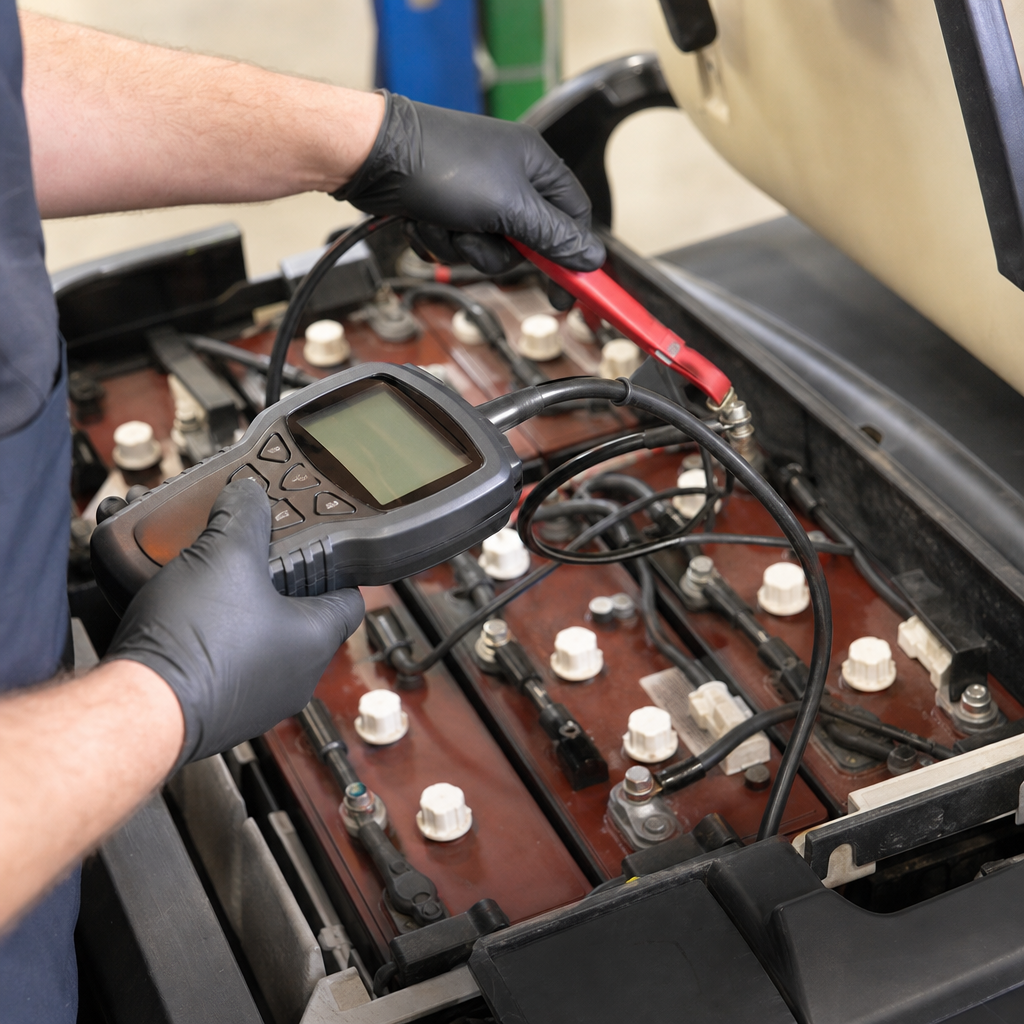
Pinehurst Golf Cart Repair brings the shop to your driveway. Our tech arrives at a scheduled window anywhere in Pinehurst, Southern Pines, Aberdeen, Seven Lakes, Whispering Pines, or Carthage, runs a full diagnostic on the cart where it sits, quotes a flat price on the spot, and finishes most repairs in that same visit. The $50 to $100 service call includes the diagnostic and is usually applied toward the repair. No trailer, no drop-off, no wait list.
This is the core service, and everything else on the site (batteries, brakes, chargers, motors, tune-ups) is a specialty of it. Here is what a visit involves and why it works better than the alternative in a town like this one.
Why mobile is the right model for Pinehurst
A golf cart that will not move is the hardest vehicle you own to get to a shop. It weighs 900 to 1,100 pounds with a lead-acid pack in it, it does not fit in an SUV, and if it will not roll under its own power you need a trailer, a winch, and a second person just to load it. The traditional answer in the Sandhills has been a dealer pickup with a wait list measured in days or weeks, during which the cart sits.
The village makes that wait expensive in a way most towns do not. Pinehurst’s 2020 Census count was 17,581 residents with a median age of 57.2, and 39.2 percent of the village is 65 or older. In the neighborhoods around Pinehurst No. 6 and No. 7, inside Pinewild, Forest Creek, and the Country Club of North Carolina, and out at Seven Lakes, the cart is the short-trip vehicle: to the course, to the pool, to the mailbox cluster, to a neighbor’s. The Village’s own ordinance recognizes it, allowing registered carts on most streets posted 35 mph or less. When the cart is down, a piece of daily life is down with it.
So the service comes to you; describe the symptom and the technician can bring the likely parts.
What a mobile tech typically carries
- Battery sets in the common configurations: six 6V (36V carts) and six 8V or four 12V (48V carts)
- Solenoids, fuses, and main cables for Club Car, E-Z-GO, Yamaha, ICON, and Evolution
- Brake shoes, drums, cables, and hardware
- Tires in standard sizes, with a portable changer and balancer
- Belts, brushes, and bearings for common motors
- Light kits, mirrors, and wiring for ordinance equipment
- A load tester, hydrometer, multimeter, and charger test rig
That inventory is why most calls can finish in one visit. If your cart needs a controller or a motor that is not on hand, expect it to be ordered and fitted on one return visit.
The diagnostic, in order
A good visit starts the same way every time, because the three most expensive mistakes in cart repair all come from skipping steps.
- Load test each battery individually. Not the pack, each battery. A six-battery string is only as strong as its weakest member, and one failed battery pulls the whole pack down to its level. On a young pack, replacing that one battery is the fix; on an old pack, it is not, so ask which you have.
- Pack voltage under load. Voltage gets read with the cart actually pulling current, not at rest. A pack that reads 50 volts sitting still and sags to 40 under load is telling you something a resting reading hides.
- Hydrometer, cell by cell, on flooded packs. Specific gravity shows whether a battery is discharged, sulfated, or has a dead cell, which the voltmeter alone cannot.
- Charger output at the plug. A charger that turns on but delivers low current starves a healthy pack and imitates battery death perfectly. This test takes two minutes and saves people $1,000 regularly. See charger repair.
- Cables and terminals. Corrosion on a main positive cable adds resistance to every amp the motor draws. In a humid Sandhills garage that corrosion builds year-round.
- Solenoid and controller. A click with no motion, no click at all, or a cart that surges each point to a different part of the drive system. Throttle input, solenoid contacts, and controller output all get tested before anything is condemned. See motor and controller repair.
You get the findings in writing whether or not you approve the repair.
What the Sandhills do to a cart
The ground under Pinehurst is sand. The USDA soil survey for Moore County maps the Candor-Ailey-Vaucluse association across about 50 percent of the county, all of it in the southern Sandhills end, and describes the Candor series as somewhat excessively drained sand with rapid permeability. That loose sand rides in on tires and settles into brake drums, wheel bearings, and pedal linkages. It is why brakes and tires here wear on a faster clock than the same cart would on a Piedmont clay lot.
Then the weather. NOAA’s 1991 to 2020 normals for the Carthage station show a July average high of 90.3°F with about 55 days a year at 90°F or above, and a January average low of 30.6°F with about 62 nights at or below freezing. Summer heat evaporates electrolyte and speeds up sulfation in flooded batteries; winter cold cuts the current a marginal battery can deliver, which is when the weak one in the string strands you. Longleaf pine pollen in early spring coats battery tops and vents. The year-round tune-up service is built around that calendar.
Street carts and the ordinance
Village of Pinehurst ordinance section 71.17 requires mirrors on any cart run on village streets, current village stickers front and rear, a licensed driver, and lights meeting specific visibility distances (300 feet front, 200 feet rear) for any operation between sunset and sunrise. A lot of mobile calls in the village are ordinance work: a light circuit that quit, a mirror knocked off, brakes that need to pass a hard-stop test before the cart goes back on Midland Road’s side streets. Lighting and brake work on a street cart is safety work. The ordinance guide covers every rule.
Common calls, and what they usually are
| What you describe | What it usually is | Typical cost |
|---|---|---|
| Clicks but will not move | Solenoid contacts, or weak pack under load | $100 to $250 |
| No click, no movement | Fuse, key switch, cable, or controller input | $75 to $300 |
| Will not charge | Charger, charge port, or over-discharged pack | $100 to $800 |
| Short range, slow on hills | Aging pack, or one bad battery | $1,200 to $1,800 pack |
| Surges or jerks | Throttle input, controller, or motor brushes | $150 to $600 |
| Squeal or grab when braking | Sand in drums, worn shoes | $75 to $250 |
| Pulls to one side | Tire pressure or wear, brake drag | $75 to $150 per tire |
Every range is on the pricing page.
Honest limits
We are an independent mobile service, not an authorized dealer or warranty center for any manufacturer. If your cart is still under factory warranty, the selling dealer is the right call for warranty work. We will also tell you when a repair does not make sense: a 20-year-old cart with a rusted frame does not need a new battery pack, it needs a straight conversation about what it is worth.
Book a visit
Tell us the brand, how many batteries you count, and what the cart is doing. A photo of the battery compartment helps. A local tech can give you a flat number and a scheduling window, agreed before the visit, anywhere from Old Town Pinehurst to Seven Lakes, Southern Pines, Aberdeen, Whispering Pines, or Carthage.
Frequently Asked Questions
What can you actually fix in my driveway?
Nearly everything a cart needs: battery packs, solenoids, controllers, motors, chargers and charge ports, brakes, tires, belts, cables, lights, and mirrors. Mobile techs commonly carry the common parts for Club Car, E-Z-GO, Yamaha, ICON, and Evolution, so many jobs finish in one visit. A rare part gets ordered and installed on a quick return trip.
How does the service call work?
It is $50 to $100 depending on where you are in Moore County, and it covers the trip plus a full on-site diagnostic: load test on every battery, pack voltage under load, charger output, solenoid and controller checks. Approve the repair and the fee is applied to the total.
Do I need to do anything before you arrive?
Leave the cart where the tech can reach both sides of it and get to the battery compartment, and if the charger lives on the wall, leave it plugged in so it can be tested under real conditions. If you are inside a gate, let the guardhouse know. That is it.
How fast can you get to Pinehurst?
It is set by that week's schedule, and the window is given before anyone comes out. Pinehurst, Southern Pines, and Aberdeen sit within about 10 minutes of each other; Seven Lakes, Whispering Pines, and Carthage are 18 to 20 minutes out. A good description of the symptom lets the tech load the likely parts before leaving.
Do you work on gas carts too?
Yes. Electric carts are the majority in Moore County, but gas carts get the same driveway service: starter-generators, belts, carburetors, fuel systems, plugs, and filters.